
Showing posts with label PTSD. Show all posts

Tuesday, 26 May 2020

Coping with Anniversaries

Emily shares some tips for making anniversaries of loss or traumatic events easier to cope with.


- Emily Maybanks


Anniversaries of either a loss or a traumatic event are hard, but, from personal experience, there are things to do which can ease the difficulty a little. For context, I lost my Dad to cancer in 2012 when I was 17; although this was a long time ago now, there is absolutely no time limit on grief and I still find the anniversary of his death, and indeed Father’s Day every year, emotional. In May 2018, I was the survivor (I prefer the term survivor to victim) of an assault during a coach journey back to university for my final ever university exam. The anniversary of this event is also tough. 

Things which I have found have helped me to cope better around the anniversaries of both my Father’s death, and the assault, include firstly using your support network of friends and colleagues for example. For the most part, I am fortunate that they are understanding and supportive. Whether I need to talk, or cry, or just be silent in their presence, they are there for me. Similarly, if I just need a hug or a distraction, I am able to turn to my friends. Of course, it is important to acknowledge that some people do not have this support network, in which case there are lots of online blogs and forums where you can seek advice and support. 

Secondly, I have found acknowledging and accepting the emotions during an anniversary to be helpful. In fact, this is healthier for our mental and physical health than bottling away these emotions. It is better for you to experience whatever emotions that might show up and to let yourself feel and process these emotions in your own time and in a place that feels safe. Telling yourself that you will be okay – for me, especially surrounding the anniversary of the assault, I often stand in front of a mirror and repeat positive statements such as “I will be okay” or “this too shall pass”. 

Thirdly, this is particularly when coping with the anniversary of the loss of a loved one, I have found it helpful to mark the day with something they would have enjoyed. For example, on the anniversary of my Dad’s death, I try to go for a peaceful walk and I also bake a cake because my Dad loved walking and he also loved my baking. This often makes the day much more enjoyable and it makes me feel that if my Dad were still to be alive, he would be happy. Sometimes, I look at old photos of myself and my Dad and remember the happier memories that we shared together, such as family holidays. 

Finally, I would say that it is important to find a way to cope that works for you, but don’t forget that there is always someone willing to listen, to hug, to support. 

Some websites which offer support for bereavement and/or PTSD include Cruse, Mind and PTSD UK . 

For more information and support see the Student Minds website.

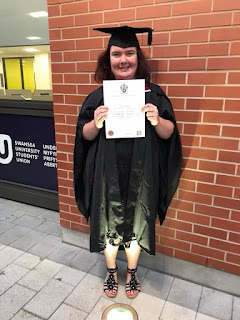
My name is Emily (Em). In 2018, I graduated from Swansea University with my BA degree in Modern Languages, Translation & Interpreting where I was also passionate about and dedicated to Swansea Student Media and the University students’ newspaper – Waterfront. In September 2020 I will be starting a PGCE at the University of Reading to train to teach Secondary MFL (French and German). I blog for Student Minds because I have experienced mental health issues as a student and now also as a graduate, as well as various other health issues, and I support friends who also have mental health difficulties. I am a passionate writer and writing has been important in my mental health experiences – both in helping me to explore and to cope with my mental health, as well as sharing my story in order to help and inspire others.

Monday, 21 October 2019

Mature Mental Health: My Journey to Realisation

Lisa shares her life-long struggle with mental health and how improving herself through education finally helped her to recognise and break the cycle.
- Lisa Knight

I was extremely slow to realise my poor mental health. Although it was right there for many, many years, I and every service I was ever referred to failed to diagnose the overarching damage that my brain had sustained in childhood.

After losing most of my twenties to depression, drugs and anxiety, my father died suddenly and in horrible circumstances. A year later I was engaged to my long-term boyfriend. I wanted something stable for myself finally: I yearned for a family.

Two years later I was married. A year after that I gave birth to my first daughter. Fourteen months later, my second daughter arrived. Nine months after that, my husband left us for another woman.

Looking back, my journey had always been rocky. I had been made homeless when I was seventeen years old, and wasn't emotionally mature enough to deal with it. I failed most of my A-level exams and lost my place at University. I'd bounced around in various jobs, finding nothing that really suited me. I always felt stifled creatively and my mental health dogged me constantly. I became a target for bullying at work, just like I had at school.

Years later, when my eldest child was three years old, I decided to do an access course. I got a distinction in every subject, received offers from all my university applications, including the same university place I had missed out on fifteen years previously. Of course, that was the university I wanted.

It was tough going with two young children. And I almost lost it all in my second year, but in the end I managed to graduate with a 2.1 in English. The following term, I started a part-time MA in English studies. However, my struggle with depression and anxiety made this an utter slog. I requested therapy with my local GP and was referred to Mind. It was in these sessions where everything finally started to make sense.

Up until this point, I had believed I was suffering with depression. However, sessions with my therapist made me aware of the pervasive anxiety of which I suffered, accompanied by flashbacks and symptoms of complex PTSD.

I was 37 years old by the time I realised the true nature of my poor mental health. I had always questioned: 'what's the matter with me?' and 'why am I like this?' Now I know that the violence and bullying behaviour I witnessed and was on the receiving end of as a child completely changed the structure of my brain. I understand that the debilitating and pervasive fear that has been a constant part of my life is due in part to an anxiety that became the norm for me in my infancy.

I handed in my MA dissertation recently, and I should graduate in January 2020. My medication has been adjusted to help with the anxiety, and for the first time in my life, my mood has stabilised. I'm on the waiting list for psychodynamic psychotherapy and I'm hoping to leave my cloudy past behind for a sweeter and sunnier future.

If you've been affected by any parts of my story, had similar experiences, or are feeling isolated and alone on your uni course, take the step and reach out for help. You've nothing to be ashamed of, and support networks like your personal tutor or the 'Help' page on Blackboard can put you in touch with the right people to get the support you need.


If you are looking for mental health support for yourself, a friend or a loved one, you can find more information and resources at Student Minds and Mind Helplines.


I'm Lisa, a post-graduate English student who started out at Uni in my early thirties. I work as a copywriter and freelance writer and hope to inspire other mature students with my experiences with mental health. It's important to know that you're not alone and that you can succeed despite everything.